Live Editing: The Game Changer for Content Teams

Live editing has become one of the most requested features in modern content management systems—and for good reason. The ability to see changes in real-time transforms how content teams work and dramatically improves productivity.
The Traditional Content Editing Experience
Traditional CMS platforms require content editors to work in abstract forms and fields, with no visual feedback about how their changes will appear to customers. This leads to:
- Multiple rounds of reviews and revisions
- Frequent mistakes and inconsistencies
- Frustration for content teams
- Slower time-to-market
How Live Editing Changes Everything
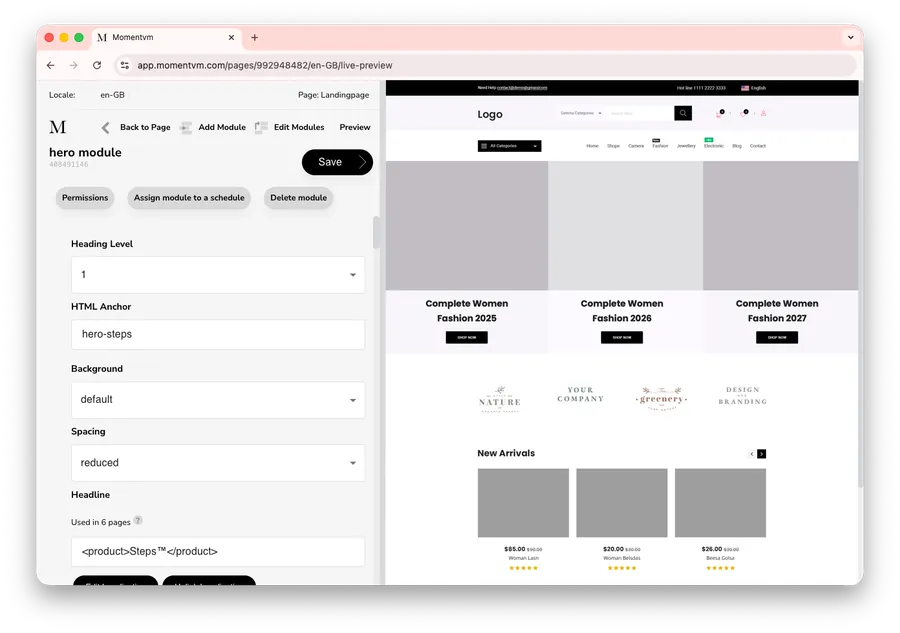
Visual Context
When editors can see exactly how their content will appear on the live site, they make better decisions and catch issues before publishing. This visual context is especially important for responsive designs where content needs to work across different screen sizes.
Faster Iteration
Real-time preview eliminates the traditional edit-save-preview cycle. Editors can try different approaches, see immediate results, and make quick adjustments—all within the same interface.
Reduced Errors
When editors can see how content renders in context, many common errors are caught before publication. Formatting issues, spacing problems, and layout concerns become immediately obvious.
Better Collaboration
Live editing facilitates better collaboration between content creators, designers, and stakeholders. Everyone can see the same preview and provide feedback based on the actual rendered content.
Implementation Considerations
While live editing is powerful, implementing it well requires careful attention to performance, security, and integration with existing systems. Look for solutions that provide:
- Fast, responsive preview rendering
- Proper permission controls
- Integration with approval workflows
- Support for complex page structures
Live Editing in Practice
Picture preparing a seasonal landing page. In a traditional workflow, you'd fill in fields, save, deploy to a staging environment, and only then discover that the hero headline wraps awkwardly on mobile or that a promotional badge overlaps the product image. Each correction restarts the cycle.
With live editing, the same work collapses into a single, continuous view: change the headline and watch it reflow instantly, swap a module, adjust spacing, and confirm the mobile layout—all before anything goes live. The feedback loop shrinks from hours to seconds, and the page that gets approved is the page customers actually see.
This matters most under pressure. When a campaign needs to ship today, the difference between "edit, deploy, check, repeat" and "edit and see" is the difference between making the window and missing it. It's the same capability that lets teams publish content updates without downtime and stay confident that what they shipped is correct.
The Bottom Line
Live editing isn't just a nice-to-have feature—it's become a requirement for modern content teams. Organizations that adopt live editing capabilities report significant improvements in content quality, team productivity, and time-to-market.
Frequently Asked Questions
What does live editing actually mean in a CMS context?
Live editing shows content changes in real time exactly as they'll appear on the storefront — instead of an abstracted editor form that only reveals a preview after saving.
Does live editing slow down storefront performance?
No, as long as the preview is technically separated from production delivery. Live editing only affects the editor environment, not actual storefront performance for end customers.
Does live editing replace the approval workflow?
No, the two complement each other: live editing improves the quality of the approval decision, because approvers see exactly what's about to go live instead of relying on a description.
Which content types benefit most from live editing?
The effect is largest for layout-heavy content like landing pages and campaign banners, where how multiple modules interact is hard to predict visually without seeing it directly.
How do systems prevent multiple editors from overwriting each other during live editing?
Modern systems show who's currently editing which content block and temporarily lock individual blocks against simultaneous changes — similar to how collaborative document editors handle concurrent edits.
Does live editing require special training for editors?
The learning curve is shallow, since the interface matches the actual storefront — editors orient themselves against something they already know, instead of learning an abstract form-based logic from scratch.
How does live editing hold up on very complex pages with many modules?
With a high module count, visual context becomes even more important, since interactions between blocks are hard to predict in a pure form-based editor. This is exactly where the quality gap versus classic editors shows up most.