Case Study: How Stokke Transformed Their Content Operations
Stokke, a leading brand in premium baby products, faced significant challenges managing content across multiple markets. Their legacy systems were slowing down operations and increasing costs. Here's how they transformed their content operations with MOMENTVM.
The Challenge
As Stokke expanded into new markets, their content management processes became increasingly complex and inefficient:
- Content updates took weeks instead of days
- Translation coordination was manual and error-prone
- No ability to preview changes before deployment
- High dependency on technical resources
- Rising operational costs
The Solution
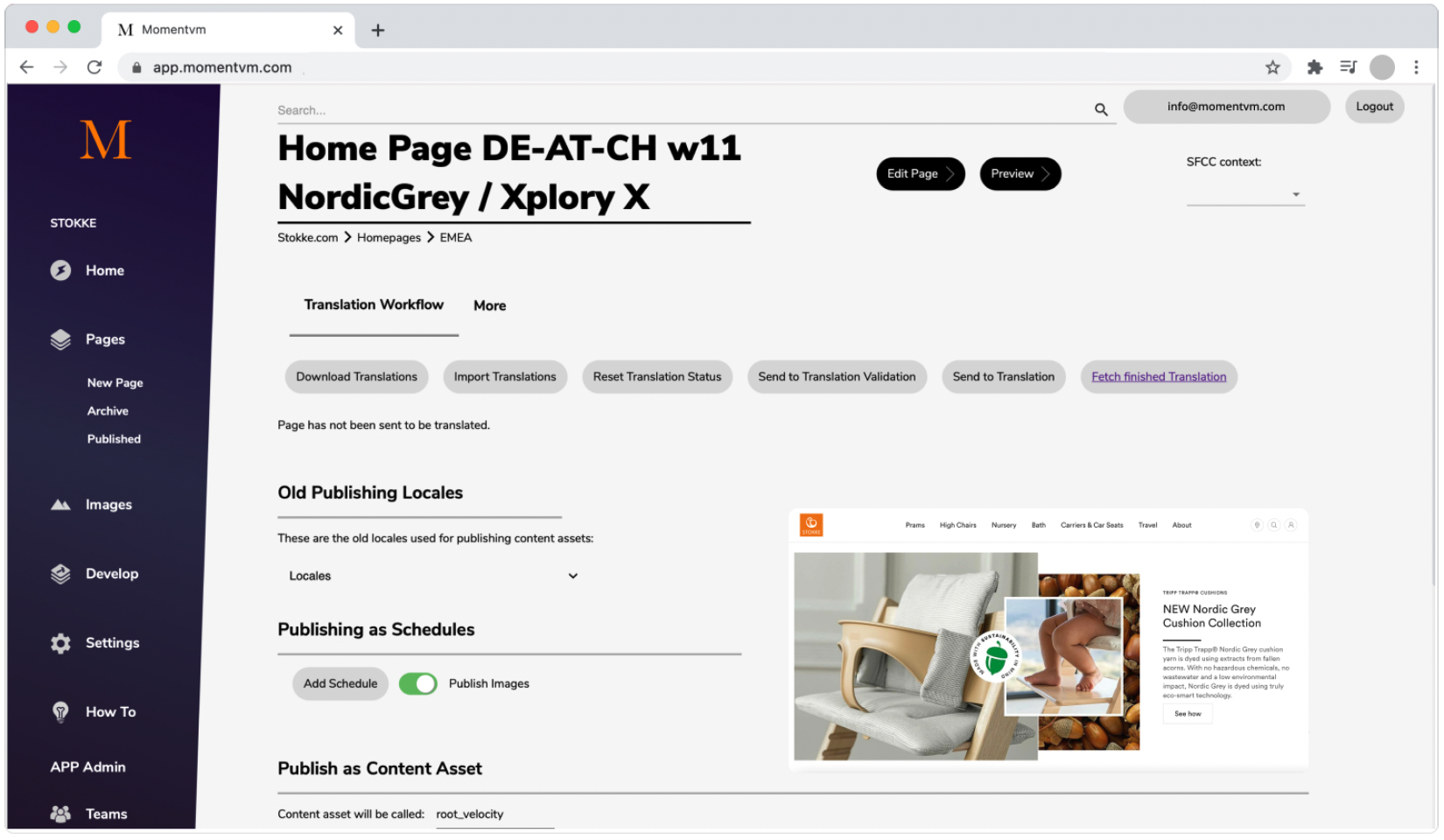
Stokke implemented MOMENTVM as their enterprise CMS for Salesforce Commerce Cloud, focusing on three key areas:
Streamlined Content Management
Live editing and real-time preview capabilities enabled content teams to work independently, without constantly relying on developers. Changes that previously took days could now be completed in hours.
Automated Translation Workflows
Integrated translation management tools reduced coordination overhead and improved translation quality. Built-in glossaries ensured brand consistency across all markets.
Faster Deployment
Simplified deployment processes and automated quality checks reduced the time from content creation to go-live by 65%.
The Results
- 65% faster deployment: Content changes go live in hours instead of days
- 40% cost reduction: Decreased dependency on technical resources and more efficient translation processes
- Improved quality: Live preview and approval workflows reduced errors
- Higher team satisfaction: Content editors can work more autonomously and efficiently
The headline number: A 65% reduction in deployment time doesn't just save effort—it means 65% more room for campaigns, promotions, and revenue opportunities with the same team.
Why It Worked: Removing the Developer Bottleneck
The single biggest change wasn't any one feature—it was who owned content. Previously, nearly every update flowed through engineering, which meant marketing moved at the speed of the release calendar. By shifting routine content work to the marketing team and leaving templates and complex logic with developers, both groups started working in parallel instead of blocking each other.
Live preview reinforced this shift. When editors can see exactly how a page renders across markets before publishing, approvals get faster and fewer errors slip through. Combined with an integrated localization workflow, Stokke could roll out the same campaign across the DACH region without re-coordinating every market by hand.
Key Takeaways
Stokke's success demonstrates that the right CMS can transform content operations. By reducing technical dependencies, streamlining workflows, and enabling real-time collaboration, brands can achieve significant improvements in both speed and cost efficiency.
For more details about this case study, contact our team to learn how MOMENTVM can help your organization achieve similar results.
Two capabilities behind Stokke's results are covered in more depth elsewhere: why live editing is a game changer for content teams, and optimizing translation workflows for global brands.
Frequently Asked Questions
What results did Stokke actually achieve with MOMENTVM?
Stokke achieved 65% faster deployments and 40% lower content management costs by replacing manual cross-market coordination with automated workflows.
How long did Stokke's transition take?
The case study describes a phased rollout, with new campaigns launching on the new system first while existing processes continued in parallel — a pattern that repeats across most successful migrations.
Does this result translate to smaller brands?
The underlying bottlenecks — manual translation coordination, developer dependency for content changes — affect smaller multi-market retailers too, just at a smaller scale.
What role did live editing play in the results?
Live editing significantly cut down iteration cycles, since content teams could make and review changes directly in the final view instead of waiting on separate preview builds.
What internal resistance did Stokke encounter during the transition?
As with most migrations, there was initial skepticism among team members accustomed to the existing, if slower, processes. That skepticism typically faded once the first campaigns went noticeably faster.
How was content migration organized at Stokke specifically?
The approach followed the pattern that's proven effective across industries: new, active campaigns moved to the new system first, historical content followed in phases by priority, instead of a risky all-at-once move on a single cutover date.
What role did operating across multiple markets play in project complexity?
As an internationally operating brand, Stokke had to solve translation coordination across multiple language versions — exactly the area where manual processes had previously cost the most time.